
Tampa Bay Rays Stadium Deal Deals Major Blow to Orlando’s MLB Ambitions
“Today’s vote represents an extraordinary milestone not simply for the Rays or for a ballpark, but for the future of Tampa and the entire Tampa Bay region.”
That statement from Tampa Bay Rays Managing Partner Patrick Zalupski captures just how much is riding on Hillsborough County’s approval of the team’s proposed $2.36 billion stadium.
This is not simply a baseball story.
It is a story about public investment, urban development, economic competition between Florida metros and potentially the future geography of Major League Baseball itself.
On August 28, 2026, Hillsborough County commissioners voted 5-2 to approve the foundational agreements behind the Tampa Bay Rays’ proposed new ballpark. Tampa City Council had approved the deal 4-3 a day earlier.
For Tampa Bay, the decision brings the Rays substantially closer to a permanent home.
For Orlando, it may close one of the most obvious paths toward landing an MLB franchise.
Text Phil Kruse at 407-782-8276 or Contact Him Here
Key Takeaways
- Hillsborough County approved the foundational agreements for a $2.36 billion Tampa Bay Rays stadium project.
- The county plans to contribute $796 million from four public funding sources.
- The Rays have proposed more than 8 million square feet of development around the stadium.
- Public funding still depends on multiple conditions, including bond validation and proof of the Rays’ financing.
- The decision substantially reduces the likelihood of the Rays relocating to Orlando.
- Orlando Dreamers leaders say they remain committed to pursuing MLB through either expansion or relocation.
- The stadium debate is about far more than baseball: infrastructure, tax revenue, real estate development, tourism and regional economic strategy are all part of the equation.
Text Phil Kruse at 407-782-8276 or Contact Him Here
Hillsborough County Approves the $2.36 Billion Rays Stadium Deal
The Hillsborough County Board of County Commissioners approved three foundational documents for the Tampa Bay Rays stadium project:
- The development and funding agreement
- The team non-relocation agreement
- The guaranty agreement
The final vote was 5-2.
Commissioners Ken Hagan, Harry Cohen, Gwen Myers, Chris Boles and Christine Miller supported the deal. Joshua Wostal and Donna Cameron Cepeda opposed it.
That same split had emerged during the county’s earlier non-binding framework vote.
The approval followed Tampa City Council’s 4-3 vote supporting the project one day earlier.
Several important agreements still have to be completed, including the community benefits agreement, ballpark license and use agreement and construction funds trust agreement.
So while this was a major milestone, it was not the final administrative step.
How Much Public Money Is Going Into the Rays Stadium?
One of the biggest questions surrounding the Rays stadium has been the size and structure of the public contribution.
Hillsborough County is expected to contribute $796 million.
That funding comes from four sources:
- $360 million from the county’s half-cent sales tax
- $303 million from Tourist Development Tax revenue
- $103 million from cash reserves
- $30 million in disaster recovery funds
Those numbers explain why the stadium has generated such an intense political debate.
The public sector is making a substantial investment, and supporters are effectively betting that the stadium and surrounding development will generate economic activity extending far beyond baseball games.
Opponents, meanwhile, are questioning whether taxpayers are receiving enough protection and economic value in return.
The County Isn’t Writing a Check Immediately
One important detail can easily get lost in the headline numbers.
Approval does not mean $796 million suddenly gets transferred to the Tampa Bay Rays.
County Attorney Julia Mandell said the financing must first go through a bond validation proceeding in court.
There are also numerous conditions that must be satisfied before Hillsborough County contributes public money.
According to Mandell, there are roughly 28 conditions precedent before county funding can begin.
The Rays will also have to provide proof of their own financial capacity.
A separate construction trust fund will hold money contributed by both sides, and the agreement governing that fund still must be finalized.
That matters because some of the most important questions in any publicly supported stadium project involve risk allocation.
Who contributes first?
Who absorbs overruns?
What happens if private financing changes?
What happens if surrounding development falls short?
The final agreements addressing those questions may ultimately be just as important as the headline stadium approval.
Why the Half-Cent Sales Tax Is Controversial
Part of the county contribution comes from the Community Investment Tax.
That has become particularly controversial because commissioners said during the tax’s 2024 voter-approved renewal that it would not be used to construct new stadiums.
The county subsequently obtained an outside legal opinion stating that the money could be used for the Rays project.
The proposed structure calls for approximately $90 million per year over four years during construction, an approach county officials say would avoid interest costs on those funds.
The legal argument may be resolved through the financing process.
The political argument may not disappear nearly as quickly.
Voters tend to remember what they were told when approving taxes, and using those revenues for a high-profile professional sports project is likely to guarantee continued scrutiny.
The Stadium Is Really a Real Estate Development Project
Evaluating the proposal strictly as a baseball stadium misses a major part of the deal.
The Rays have proposed more than 8 million square feet of development.
County projections cited in the agreement include roughly:
- 3.1 million square feet of multifamily rental development
- 450,000 square feet of office, retail, dining, hotel and entertainment space
Commissioner Harry Cohen described the project as a potential connector between the West Shore District, Midtown, Downtown Tampa, Ybor City and a future Brightline connection.
Commissioner Ken Hagan went even further, describing the vision as a “live, work, play and learn” environment because of the project’s relationship with Hillsborough College.
That is a fundamentally different proposition than simply building thousands of seats and a baseball field.
The broader economic thesis depends on whether the stadium can help catalyze an entire district.
Tampa Is Betting on a Stadium-Centered Development District
Interestingly, the agreement does not contain firm guarantees requiring the Rays to construct all of the surrounding development.
Instead, Hillsborough County negotiated an incentive structure.
Tax increment revenue generated within the project would flow through a Community Development District.
The more development the Rays build, the greater the share of incremental tax revenue flowing to the district for infrastructure, stadium capital expenses and other public purposes.
At a taxable assessed value of $650 million, the proposed split would give:
- 85% of tax increment revenue to the Community Development District
- 15% to the city and county
Supporters see that structure as a way to align incentives.
If the Rays want access to more revenue, they need to generate additional taxable development.
Commissioner Joshua Wostal raised the opposite concern.
He argued that Hillsborough County could receive only about $87 million over 35 years, calling the overall agreement extremely one-sided.
That disagreement goes to the heart of the stadium debate.
The project’s financial success will depend heavily on assumptions about future development, property values and economic activity.
The Community Benefits Agreement Is Still Unfinished
Another major piece remains unresolved.
Tampa and Hillsborough County have agreed to split their community benefits obligations 65%-35%, but a final dollar amount had not been established at the time of the approval.
Commissioner Chris Boles proposed increasing the community benefits commitment to at least $60 million.
Community benefits agreements can become a critical political component of large publicly supported developments because they address a basic question:
What does the surrounding community receive in return?
Those agreements can include workforce development, infrastructure, affordable housing initiatives, local hiring programs or other investments.
Exactly how Tampa’s agreement ultimately takes shape will be worth watching.
Why the Tampa Rays Stadium Deal Is Bad News for Orlando
The story becomes particularly significant for the rest of Central Florida.
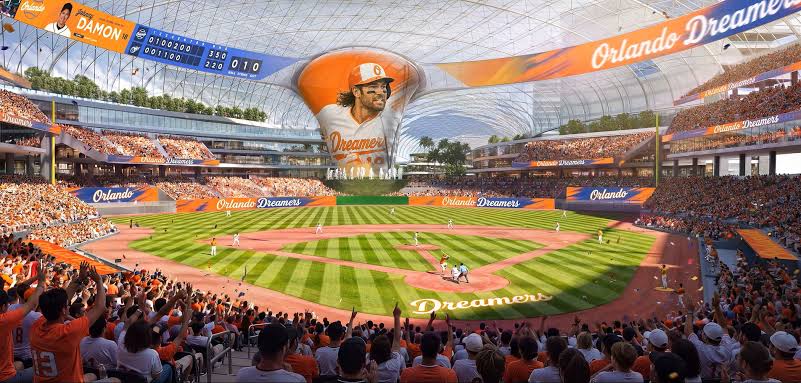
The Orlando Dreamers have been working to bring Major League Baseball to Orlando.
Their strategy has included both possible relocation and future MLB expansion.
But keeping the Rays in Tampa Bay eliminates what may have been Orlando’s most realistic relocation opportunity.
University of Michigan sports management professor Mark Rosentraub told the Business Journal that if the Rays secure a new stadium in Tampa or St. Petersburg, Orlando landing an MLB team becomes “very unlikely.”
The geographic issue is straightforward.
Florida already has two Major League Baseball franchises: the Rays and Miami Marlins.
Adding another franchise roughly 85 miles from Tampa would create another MLB market in a state where existing teams have historically faced attendance challenges.
That does not make Orlando impossible.
It does make the argument more complicated.
Orlando Dreamers Aren’t Giving Up
The Orlando Dreamers immediately made clear that they do not see the Tampa stadium vote as the end of their campaign.
The organization said it remains committed to bringing MLB to Orlando through either relocation or expansion and said its effort is supported by more than $2 billion in private investment commitments.
That private capital is significant.
But Orlando recently suffered another setback when its latest attempt to secure Orange County Tourist Development Tax support was rejected.
The Dreamers may now increasingly have to make an expansion-focused argument.
Instead of asking which existing franchise could move to Orlando, the central question may become:
Why should Major League Baseball create a new franchise for Orlando?
That requires a different sales pitch.
Orlando’s Best MLB Argument May Now Be Market Growth
With the Rays moving closer to a long-term home in Tampa, Orlando’s case may increasingly depend on proving that Central Florida can independently support Major League Baseball.
That argument would likely need to focus on factors such as:
- Population growth
- Corporate sponsorship potential
- Tourism
- Regional television and media opportunities
- Stadium financing
- Season-ticket demand
- Private investment
- Transportation access
- Long-term population and income growth
The Tampa Bay Rays staying in Tampa makes proximity a weakness in Orlando’s expansion argument.
Orlando therefore needs its economic strengths to become compelling enough that MLB views the market as additive rather than cannibalistic.
The Bigger Question: Do Stadiums Actually Create Economic Growth?
This stadium deal also raises a question that comes up whenever governments provide hundreds of millions of dollars for professional sports facilities.
Will the public investment produce enough economic activity to justify the cost?
Supporters believe this project is different because the stadium sits within a massive mixed-use district.
Their argument is not simply that baseball games will create economic activity.
It is that the stadium can serve as an anchor for residential development, offices, restaurants, hotels, retail, transportation infrastructure and entertainment.
That could turn the surrounding area into a major destination regardless of whether the Rays are playing that night.
Critics have a different concern.
If much of the spending merely shifts from elsewhere in Hillsborough County into the stadium district, the economic gain may be substantially smaller than the gross activity generated around the site.
That is why the development component matters so much.
A stadium alone is one economic proposition.
A stadium surrounded by millions of square feet of genuinely incremental development is another.
The Rays Deal Could Reshape Tampa for Decades
The Tampa Bay Rays stadium debate has officially moved into a new phase.
For years, the question surrounding the Rays was essentially:
Where will this team eventually play?
Now the bigger question is:
What kind of district will Tampa build around them?
If the proposed development succeeds, the stadium could become a centerpiece connecting several of Tampa’s most important growth corridors.
If development falls short of expectations, taxpayers and local officials could spend decades debating whether the public contribution was justified.
Meanwhile, Orlando’s MLB ambitions have not disappeared.
But the path has become narrower.
The Dreamers may now need Major League Baseball expansion, rather than Rays relocation, to become the centerpiece of their strategy.
That makes the Tampa stadium vote one of the more consequential sports-business decisions in Florida.
It is not simply deciding where the Rays play baseball.
It could also help determine where Major League Baseball grows next.
What do readers think? Is Hillsborough County’s $796 million contribution a smart investment in Tampa’s long-term growth, or is the public sector taking on too much risk? And with the Rays increasingly anchored in Tampa, does Orlando still have a realistic case for an MLB expansion team?
When evaluating stadium deals like this one, the best approach is to look beyond the ballpark itself. The financing, development commitments, tax structure and public protections will ultimately determine whether the project delivers on its promises.
Text Phil Kruse at 407-782-8276 or Contact Him Here