
Downtown Orlando Infrastructure: Magnolia Avenue Transformation Signals Bigger Changes Ahead
“We’re definitely on an upswing; I think today is a testament to that.” Frank Vertolli
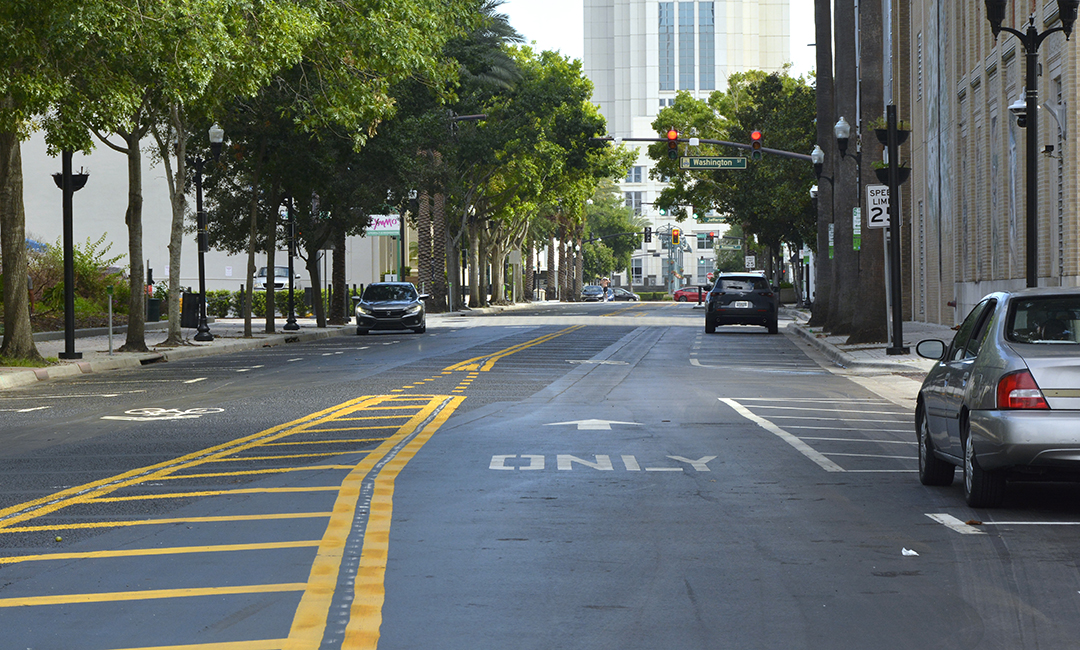
For the first time in roughly 70 years, drivers can travel both directions on a major stretch of Magnolia Avenue in downtown Orlando.
The change may sound relatively simple, but the Magnolia Avenue two-way conversion represents something much bigger.
The $2.8 million first phase converted the downtown corridor from one-way to two-way traffic, dramatically increased on-street parking and changed how residents, visitors and customers can reach businesses along the street.
It also provides an early look at Orlando’s much larger effort to rethink how people move through downtown.
Magnolia Avenue is only one piece of a broader wave of downtown Orlando infrastructure projects involving streets, public gathering spaces, pedestrian improvements, parking and transportation.
Together, those investments could significantly change what downtown Orlando looks and feels like over the next several years.
Text Phil Kruse at 407-782-8276 or Contact Him Here
Key Takeaways
- Magnolia Avenue has returned to two-way traffic for the first time since the 1950s.
- The $2.8 million first phase runs between South Street and Livingston Street.
- On-street parking increased from only nine spaces to more than 100.
- The project is designed to improve access to downtown businesses and make navigation more intuitive.
- Magnolia Avenue is one piece of a broader group of downtown infrastructure investments involving streets, green spaces and public gathering areas.
- Church Street is being transformed into a more flexible, pedestrian-oriented festival street.
- The Canopy will create a major public gathering space beneath Interstate 4.
- Additional two-way conversions are planned for Orange and Rosalind avenues.
- The larger strategy is focused on making downtown Orlando easier to access, more walkable and more supportive of businesses.
Text Phil Kruse at 407-782-8276 or Contact Him Here
Why Magnolia Avenue Was One-Way for 70 Years
To understand why the Magnolia Avenue project matters, it helps to look at why the street became one-way in the first place.
Magnolia Avenue was converted to one-way traffic in the 1950s during an era when downtown transportation planning was heavily focused on moving commuters through urban centers as efficiently as possible.
Interstate 4 changed commuting patterns across Orlando, and streets such as Magnolia were designed largely around moving vehicles.
But downtown Orlando has changed.
It is no longer simply somewhere commuters enter in the morning and leave at the end of the workday.
Downtown increasingly serves residents, restaurants, entertainment venues, businesses, cultural institutions, sports facilities and visitors.
That creates a different transportation challenge.
Instead of simply moving cars through downtown quickly, planners are increasingly considering how streets can help people actually reach businesses, park, walk between destinations and spend more time in the area.
The Magnolia Avenue conversion reflects that shift.
More Than 100 Parking Spaces Could Make a Difference for Businesses
One of the most tangible changes may be parking.
Before the project, Magnolia Avenue had only nine on-street parking spaces along the affected corridor.
The conversion increases that number to more than 100.
For downtown businesses, that could be significant.
Parking is often one of the first concerns raised by customers considering whether to visit a downtown restaurant, store or service business.
Even when garages are available nearby, convenient curbside parking can make businesses easier to discover and access.
Increasing parking also changes how the street functions.
Instead of operating primarily as a corridor designed to move traffic, Magnolia Avenue can provide more opportunities for people to stop.
That distinction matters for a downtown business district.
A successful commercial street generally needs more than vehicles passing through it.
It needs people arriving, parking, walking and spending money.
Two-Way Traffic Could Make Downtown Easier to Navigate
Downtown street grids can be confusing for visitors unfamiliar with one-way roads.
Missing a destination may require circling several blocks before returning to the same location.
Converting Magnolia Avenue to two-way traffic creates a more intuitive route through downtown.
The street runs parallel to Orange Avenue and provides another north-south connection through the historic business district.
That can help distribute traffic while giving drivers more direct access to individual blocks.
The City of Orlando's broader downtown strategy places significant emphasis on this idea.
Street design is increasingly being viewed not simply as a transportation issue but as part of the overall downtown experience.
If residents and visitors find downtown difficult to navigate, that friction can influence where they decide to eat, shop, work or spend an evening.
Simplifying the street network is one way Orlando is attempting to reduce that friction.
The Goal Is Also Economic Development
The Magnolia Avenue conversion is closely tied to the city's broader effort to support downtown businesses.
Infrastructure alone will not fill vacant storefronts or guarantee that new companies move downtown.
But streets, sidewalks, parking and public spaces help create the environment in which businesses operate.
Better access can make a restaurant easier to visit.
Additional parking can make a retail storefront more convenient.
Improved sidewalks can encourage customers to walk between multiple businesses.
Public gathering spaces can create foot traffic.
That is why the physical changes underway downtown are increasingly being paired with business-support and economic-development programs.
The strategy is essentially to improve both the physical environment and the reasons people have to use it.
Magnolia Avenue Is Only the Beginning
The significance of the Magnolia Avenue project becomes clearer when viewed alongside everything else planned for downtown Orlando.
The city is pursuing a much broader transformation of streets and public spaces.
Several major projects are either underway or approaching construction.
Among the most visible is Church Street.
Church Street Is Being Reimagined as a Festival Street
Church Street has played an important role in downtown Orlando's history as an entertainment and nightlife destination.
The current infrastructure project is intended to make the corridor more flexible.
Rather than functioning exclusively as a conventional street, portions are being redesigned to better accommodate pedestrians, outdoor dining, events and everyday vehicle traffic.
The concept is commonly described as a festival street.
The design includes a more flexible roadway configuration capable of supporting different uses depending on what is happening downtown.
On an ordinary day, vehicles can move through the corridor.
During an event, the space can place greater emphasis on pedestrians and public activity.
That flexibility reflects another change in urban planning.
Streets do not necessarily have to serve only one purpose.
In dense downtown environments, the same public space can potentially support transportation, commerce, entertainment and community events.
The Canopy Could Turn Space Under I-4 Into a Destination
Another major piece of Orlando's downtown redevelopment is The Canopy.
The project is designed to transform roughly 10 acres beneath Interstate 4 into an urban gathering area.
Space underneath highways has traditionally been treated as leftover infrastructure.
The Canopy takes a different approach.
The city plans to use the area for recreation, community activity, mobility connections, greenery and public art.
The location is especially significant because Interstate 4 cuts through the western side of downtown.
Creating an active public space underneath the highway could help strengthen connections between surrounding sports, entertainment and downtown districts.
Instead of functioning primarily as a barrier, the infrastructure could become part of the public realm.
The project is expected to continue developing through 2027.
Orange and Rosalind Avenues Could Be Next
Magnolia Avenue is not expected to be Orlando's last major two-way conversion.
Additional changes are planned for Orange and Rosalind avenues.
The broader concept is similar: move away from wide, high-speed one-way corridors and create streets that balance vehicle movement with parking, transit, pedestrian access and surrounding businesses.
That represents a substantial shift in how downtown's road network could function.
If those projects move forward as planned, the experience of driving through downtown Orlando several years from now could be considerably different.
But the impact could extend well beyond drivers.
Changes to curb space can create parking and loading areas.
Street redesigns can influence pedestrian conditions.
Transit can be integrated differently.
Landscaping and streetscape improvements can make blocks more inviting.
The transformation is therefore less about changing arrows on street signs and more about redefining the purpose of the street.
Why Walkability Matters for Downtown Orlando
Walkability has become a recurring theme in Orlando's downtown planning.
That makes sense because a downtown works differently from a suburban commercial district.
In a suburban setting, a visitor may drive directly from one business to another.
A downtown benefits when visitors can park once and reach several destinations on foot.
A person might attend an event, walk to dinner, visit a bar and stop somewhere else before returning to a vehicle.
Each additional stop potentially creates economic activity.
The quality of the space between those destinations matters.
Wide sidewalks, shade, lighting, crossings, landscaping and active storefronts can all influence whether someone is willing to walk several blocks.
Road projects therefore become economic-development projects as well.
Downtown Orlando Is Trying to Create More Reasons to Stay
The broader challenge for downtown Orlando is not simply getting people into the urban core.
It is encouraging them to spend time there.
Sports and entertainment venues already bring significant crowds downtown.
The Kia Center, Inter&Co Stadium and Dr. Phillips Center for the Performing Arts all generate activity.
Restaurants, nightlife, offices and residential buildings create additional demand.
The next step is connecting those destinations through streets and public spaces that encourage people to explore more of downtown rather than arriving for one activity and immediately leaving afterward.
Projects such as Magnolia Avenue, Church Street and The Canopy all contribute to that strategy in different ways.
Magnolia focuses heavily on circulation and access.
Church Street combines mobility with entertainment and pedestrian activity.
The Canopy focuses on public gathering space and connections.
Together, they represent a broader attempt to make downtown function as a connected district instead of a collection of individual destinations.
There Will Still Be Growing Pains
Large infrastructure programs inevitably create disruptions.
Road closures, construction equipment, temporary parking changes and traffic detours can create challenges for businesses operating inside construction zones.
That creates a difficult balance.
The businesses expected to benefit from long-term improvements may also experience some of the greatest short-term disruption while those improvements are being built.
How Orlando manages construction phasing, access, signage and communication will therefore matter.
Maintaining pedestrian access and helping customers understand how to reach businesses can be just as important as completing the physical infrastructure itself.
The success of the downtown transformation will ultimately be measured not only by what is built but also by whether businesses and residents benefit from the finished environment.
What Magnolia Avenue Could Tell Orlando About Future Projects
Magnolia Avenue effectively serves as an early test of a larger downtown strategy.
The project can provide useful information about how drivers respond to two-way traffic, how additional parking is used and whether businesses experience improved access.
Those lessons could influence future work on Orange Avenue, Rosalind Avenue and other downtown corridors.
If the changes make downtown easier to navigate without creating major traffic problems, they could strengthen the case for similar conversions elsewhere.
If unexpected problems emerge, future projects can be adjusted.
That is one advantage of implementing a broader downtown plan in phases.
Each completed project provides information for the next.
The Bigger Downtown Orlando Transformation
For decades, much of downtown Orlando's transportation infrastructure was designed around a simple priority: move commuters efficiently.
The priorities are becoming more complex.
Today's downtown has to serve residents.
It has to support businesses.
It has to accommodate visitors.
It has to connect entertainment and cultural venues.
It has to work for pedestrians, transit users, cyclists and drivers.
And it has to create public spaces where people actually want to spend time.
The downtown Orlando infrastructure projects now underway represent an attempt to balance all of those needs.
Magnolia Avenue may be one street, but its transformation reflects a much larger shift in thinking.
A road that spent roughly seven decades carrying traffic in one direction now carries it both ways.
More than 100 parking spaces have been added.
Church Street is being redesigned.
The Canopy is moving forward.
Additional street conversions are planned.
Each project addresses a different piece of downtown, but together they point toward the same objective: creating a downtown that is easier to reach, easier to navigate and more inviting once people arrive.
What Happens Next Will Matter Most
The ribbon cutting on Magnolia Avenue marked the completion of one project, not the end of downtown Orlando's transformation.
The real impact will become clearer as surrounding projects move forward and residents, visitors and businesses begin using the redesigned streets.
The next several years will show whether the combination of two-way roads, additional parking, pedestrian improvements and new public spaces changes how people experience downtown.
For Central Florida residents, business owners and investors, these projects are worth watching closely.
Infrastructure may not generate the same attention as a new skyscraper or entertainment venue.
But streets and public spaces determine how all of those destinations connect.
And the success of downtown Orlando's next chapter may depend as much on those connections as on the buildings themselves.
The question now is whether these infrastructure investments can turn easier access into more activity, stronger businesses and a downtown where people choose to stay longer.
Text Phil Kruse at 407-782-8276 or Contact Him Here